
Updated October 29th, 2026.
Video games deserve credit for introducing us to some of pop culture’s most iconic characters. From familiar faces like Super Mario and Sonic the Hedgehog to newer characters such as Kratos and Cuphead, there is no shortage of stand-out personalities.
These characters are intriguing, but perhaps even more noteworthy are the creative individuals behind them. Blending storytelling and artistry, character designers can bring any persona to life, delivering a deeper emotional connection and an immersive gaming experience.
Experts believe that characters play a crucial role in determining the overall success of any given video game. Speaking to their importance, a study published in the International Journal of Applied Science and Engineering Review states, “The shaping of personality characteristics can make the image of the game character more realistic and three-dimensional, strengthen the attraction to players and drive the sales of the entire game from the perspective of the character.”
Are you intrigued by the video game character design process? Read on to discover exciting opportunities for creating memorable game characters — and how the industry’s best and brightest designers breathe life into their creations.
What Are the Fundamentals of Character Design?
Each character begins as a simple vision or idea, captured in the imagination of an artistic visionary. That being said, some characters are more utilitarian — created to fill specific needs in the story or world of a particular game.
Most characters encompass a blend of artistry and functionality, as explained in the peer-reviewed journal Games and Culture. This analysis highlights the frequent “combination of a (functional) avatar and a (fictional) character pole.” Done right, qualities and traits can “transform basic character functions such as ‘the helper’ or ‘villain’” into nuanced and relatable individuals.
No matter how these newfound characters materialize, they must follow basic character design fundamentals. We highlighted the basics below, along with valuable character design tips:
The Role of Character Design in Games
In a crowded industry, it is increasingly difficult for games to stand out and attract attention from their target audiences. What’s one of the most effective strategies for making a splash? Creating a cast of memorable characters. This can be accomplished even without a singular, standout character. All that’s needed is a cohesive and focused art style that draws various characters together.
From the main hero characters (controlled by players) to non-player characters (NPCs) — and the disposable cannon fodder enemies that make up so many of our favorite games — each character must possess a unique identity while remaining true to the overarching game aesthetic.
Key Elements of Memorable Characters
When you picture iconic video game characters, who comes to mind? Perhaps you smile fondly at the thought of Mario’s familiar red and blue outfit. Also memorable are the ridiculous hair and obscenely long sword wielded by Cloud Strife from Final Fantasy VII. These bold features reveal the power of foundational character design techniques.
Consider: Would Mario be as popular if he was outfitted in black and white? Would Cloud give off the same vibes without that shock of hair and oversized weapon?
These characters are the result of meticulous design, not to mention a keen eye and an adept sense of style. Each possesses unique visual features and a compelling backstory, complete with individual strengths and flaws, to form a fully-fleshed personality. Bold features allow designers to make the leap from aesthetic qualities to functionalities.
Experts at the National Videogame Museum highlight Mario’s use of the Japanese storytelling principle “kishotenketsu,” which is derived from Manga but with video games involves a “four-stage structure that introduces an idea, develops it, introduces a new twist and then gives the player a chance to demonstrate what they have learned.” Even when this approach is abandoned, however (as in the “unforgivingly hard Super Mario Bros. 2”), a powerful character keeps the player engaged enough to work through challenging gameplay.
How Do You Design a Compelling Game Character?
Creativity is a must, but there is no singular or straightforward process for developing a compelling character. This is often one of the most challenging aspects of game development. Still, designers can turn to fundamentals to guide this process:
Developing a Strong Concept
Characters come in all shapes and sizes; it’s up to artists to decide if they want their creations to convey strength, speed, power or other attributes. Beyond this, character aesthetics should align with general demeanor.
For example, a simple pair of sunglasses or a backward hat can convey attitude. The goal? To find that sweet spot in which players can identify with characters — but without causing characters to feel cliche or derivative.
Emphasizing the fundamental role of the central concept in video game design, a BBC Bitesize feature states, “Concept artists design the world that films and games are set in, design the characters, their clothes, environments, the homes they live in, the props that they use. Everything has to be designed before the film or the game can be made.”
Streamlining Visual Design
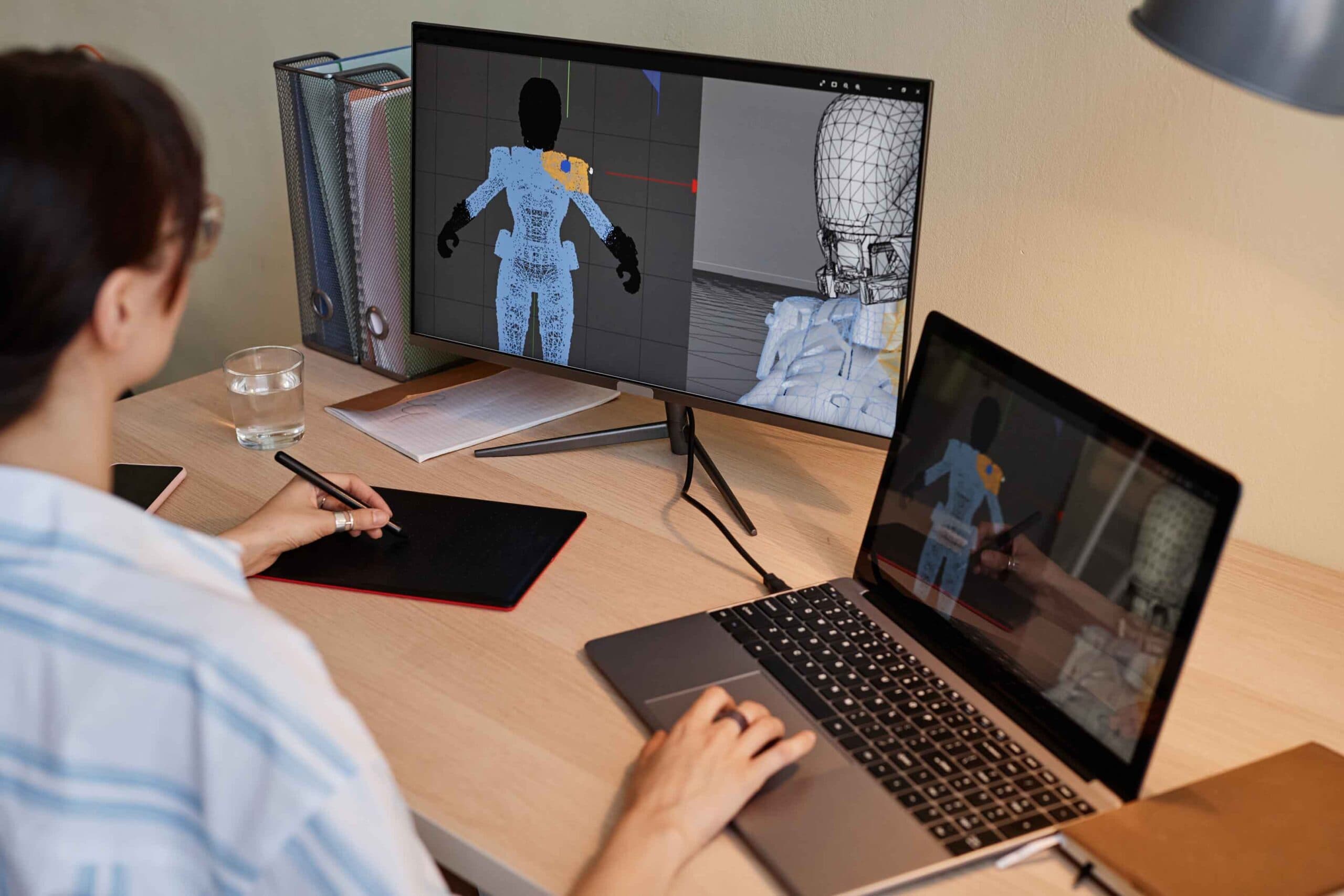
Those looking to amplify their artistic talents should expect to use today’s most cutting-edge character design tools and technologies. Designers must integrate technological prowess with artistic talent. This begins with basic sketches but eventually involves 3D modeling and rigging.
While procedural character generation is here to stay, there’s no substitute for characters designed and built from the ground up by talented artists. Those with an unparalleled grasp of the language of visual design will remain a solid step ahead of the ever-evolving AI and procedural generation systems.
Ideally, these artistic skills will join forces with technological competencies to improve the visual design workflow. The goal, as highlighted in an Entertainment Computing guide to procedural generation game maps, is to develop systems that, although efficient, still value human involvement — adding that, ultimately, “Designers are the engineers of the player experience.”
Expression and Body Language
Players can learn a great deal about characters simply by observing their expressions and body language. For instance, expressive eyes or eyebrows peaked in peculiar ways can give characters a touch of flair. Similarly, an athletic stance (or intimidating presence) can help players know what to expect from the games their characters inhabit.
In Game Design & Development, Lusine Ustyan explains that gestures and facial expressions are critical elements of visual design. They share fundamental features such as shape and color that will ultimately be “visually inspected by the game players.”
What Tools Are Used for Game Character Design?
Today’s artists have a wide variety of tools and character design software solutions at their disposal. These make a difference in every phase of the creation process. While some artists prefer traditional by-hand methods, others dive fully into the digital realm. With so many ways to bring art to life, creators are only bound by the limits of their imagination.
Traditional vs. Digital Character Design
Some early versions of character concept art involved graph paper, as artists needed to know exactly how many pixels their characters would contain. With the resurgence of retro-style pixel art in games, this method remains relevant but now involves computer software.
This looks a bit different for 3D characters. Some begin life as simple drawings on a page but eventually make the leap into the third dimension. Others are created entirely within graphic design software, illustrating that there is no one ‘right’ form of artistic expression.
The most successful solutions integrate human ingenuity with technological efficiency. Emerging engines highlighted by the BBC “allow developers to add realism to game worlds and emotional depth to characters.”
Iteration and Refinement
The world’s most popular video game characters navigated several phases of iteration and refinement before they became the titans we know today. Some refinements occur because artists’ visions change. Others involve more practical, game-related purposes. A character may become shorter or taller in order to fit the physical game world better — or may receive a color swap to stand out on the screen.
Speaking to the importance of iteration in all aspects of game design, an NPR discussion on game economics illuminates that an iterative approach limits the need for “spend[ing] years working on an update and hoping players will like it,” instead granting the “ ability to tweak things, to change paths.”
Still, a strong concept can form an essential foundation amongst all these potential changes. As Wailin Wong puts it, “One of the big things that … a lot of game developers have found is that players really like cosmetics.”
How Do You Make a Game Character More Engaging?
The expression “show, don’t tell” applies to not only television and movies but also video game art design. Characters who exude personality are more likely to become fan favorites than those who require long-winded monologues. Therein lies the need for nuanced storytelling, along with practical tools such as character design reference sketches to help bring fledgling ideas to life.
Integrating Storytelling Into Character Design
In the original God of War on PlayStation 2, the main character, Kratos, is cursed to have the ashes of his deceased family bonded to his skin. This ashen appearance earns him the nickname “Ghost of Sparta” and is a perfect example of integrating storytelling into the design of a character.
Small but meaningful touches can add an extra layer of depth to characters and make it easier for players to form emotional connections. Ultimately, the character’s design and the narrative have a two-way relationship, capable of strengthening one another while elevating gameplay. As an analysis created for the Graphics Interface Conference 2018 explains, “Well-designed characters are the foundation of storytelling in many different digital media formats. In most games, the experience of such characters is crucial to the immersion in games.”
Designing for Different Game Genres
Artists must be mindful of genre-specific concerns when designing their characters. Otherwise, they run the risk of confusing or distracting players. A guide to genre theory published in the Athens Journal of Mass Media and Communications asserts that “players should instantly recognize a genre of game, characterized by a particular style.”
A relatable example of this phenomenon is Japanese role-playing game (RPG) characters, notorious for their flashy outfits — loaded with unnecessary buckles and straps — and their impractical armor. Fans adore this flair, yet it would be out of place in any other genre.
What Are Examples of Iconic Game Character Design?
Several video game characters qualify as pop culture icons due to their compelling designs. Future gaming innovators can draw character design inspiration from these icons:
Mario from the Super Mario Series
Boasting the world’s most famous mustache, Super Mario has evolved from his humble beginnings in Donkey Kong to the star of his own smash-hit movie. Through the decades, Mario has undergone several transformations, making the leap from early 2D games into 3D and beyond.
Key features include Mario’s red and blue outfit (reflecting the power of color theory in character design), plus an M-adorned hat and that unmistakable mustache. As a BBC retrospective explains, these elements helped creator Shigeru Miyamoto achieve the ultimate goal of forming an instantly recognizable “protagonist that could make recurring cameos across different games.”
Lara Croft from the Tomb Raider Series
The PlayStation generation brought 3D graphics to the mainstream — and few characters benefited more than Lara Croft. At the time of its release in 1996, Tomb Raider was one of few games to feature a strong female protagonist. Her dual pistols and cunning demeanor made her a true standout and an inspiration to this day. Perhaps this explains why, during the 20th Bafta Game Awards, Lara Croft was deemed the “most iconic video game character of all time.”
Master Chief from the Halo Series
The original Xbox launched with arguably the best “killer app” ever: Bungie’s Halo. While many other games have employed the silent protagonist, Master Chief exudes a level of cool and confidence that few can match. Gaming reporter Steffan Powell even tells BBC that Master Chief has “become synonymous with Microsoft’s console.”
Geralt of Rivia from The Witcher Series
When bringing the literary sensation The Witcher to the gaming world, designers faced the challenge of conveying Geralt of Rivia’s rugged personality while adding a touch of fantasy mystique. He came to life with help from his silver hair, a deep vertical scar, and even a wolf medallion.
These small details make a world of difference, as expressed in an NPR feature about the game’s storytelling genius: “It is rare for a big game to be so focused on the small things. Exceedingly rare for it to be made up, more or less, of a thousand trivial, funny, sad, often pointless stories which all, in their way, cut the path that the plot will ultimately follow.”
What Do Professional Character Designers Say About Their Process?
Talented game designers are happy to share insights into their sources of inspiration and even their workflows. To that end, we’ve compiled helpful quotes and advice from the industry’s most dynamic designers:
Interview with Tetsuya Nomura (Character Designer for Final Fantasy Series)
Stating in his social media bio, “I like belts and zippers,” Tetsuya Nomura provides the perfect example of Japan’s flamboyant RPG style. He credits his background in advertising artwork for helping his work as a video game designer stand out.
In an interview marking the 30th anniversary of Final Fantasy VI, Nomura explained, “I liked to make [planning documents] as if I was going to use them in a presentation — I wrote the text by hand, including my fair share of pictures, and I tried to make the letters really stand out.” He adds that this was a collaborative experience: “Everybody pitched in when it came to brainstorming ideas.”
Interview with Shigeru Miyamoto (Creator of Mario and The Legend of Zelda)
There’s no denying that Shigeru Miyamoto has a knack for creating relatable characters. Speaking with NPR, he says, “Mario became so popular because the actions in the Mario game are something that are innate to humans everywhere.” He highlighted the instinctual fear of falling from a great height, adding that the “simplicity of these experiences as well as the interactive nature of controlling the character … resonated with people.”
Interview with Yoji Shinkawa (Character Designer for Metal Gear Solid Series)
Credited with sparking the game industry’s most recognizable artwork, Yoji Shinkawa explained in an interview for the PlayStation official blog that, while different projects call for different creative processes, he prefers to “draw many doodle-like, rough sketches to hone in on the image … I draw the designs on paper with a pencil or brush pen, scan the designs and then make adjustments in Photoshop.”
Interview with Joe Madureira (Comic Book Artist, Creator of Battle Chasers and Character Designer for Darksiders)
As both a comic book artist and a video game developer, Joe Madureira understands the power of a well-written character but also recognizes there are many ways to unleash this power. In an interview shared on the PlayStation blog, he reveals that, while the process often begins with a defined theme, “sometimes we just start drawing something cool and see where it takes us.”
What Is the Future of Character Design in Gaming?
The character design fundamentals described above are ever-relevant, but adjustments can be expected as new styles and technologies enter the picture. Tomorrow’s characters will bring greater diversity to the gaming landscape, reflecting a range of identities and experiences so that players from all walks of life can form meaningful connections. Meanwhile, technological advancements will streamline critical tasks and processes.
Emerging Trends and Technologies
Character design trends largely fall into one of two main categories: diversity and cutting-edge technology. Inclusive representation is a clear priority, with new characters reflecting a broader base of players. Additionally, development teams are seeking greater diversity, as this will help them create more relatable characters.
Artificial intelligence (AI) also looms large, and while skeptics worry that this technology will drain the creativity from game character design, it may provide valuable assistance with the more time-consuming aspects of design (like voice modulation). This may free up designers to focus more on storytelling so they can foster stronger emotional connections.
An analysis published by the Institute of Electrical and Electronics Engineers (IEEE) describes how cutting-edge tools can play a valuable role in helping games feel more immersive: “Modern computer games achieve the realism of games by integrating graphics, physics and artificial intelligence.”
Preparing for a Career in Character Design
Even as video games evolve, players will continue to crave relatable and memorable characters. Skilled character artists are in strong demand — but aspiring professionals can gain an edge by honing their artistic skills and especially by getting comfortable using advanced technological tools. The right degree program can make all the difference by offering a strong foundation in character rigging, visual storytelling, and beyond.
Bring Character Design Ideas to Life With RMCAD
Do you aspire to follow in the footsteps of the greatest game designers? Prepare for a bright future with Rocky Mountain College of Art + Design. Our Bachelor of Fine Arts in Game Art can be pursued online or on campus; either way, students stand to gain a rich understanding of the creative concepts and practical techniques that lead to iconic game characters. Reach out today to learn more.
Frequently Asked Questions: Art of Character Design
What is character design in video games?
Character design in video games is the process of creating the heroes, villains, and supporting figures that populate a game world, blending artistry with storytelling. A well-made character combines a functional role in the game with a distinct fictional personality, turning a generic part like “the helper” into someone players remember. Designers consider appearance, backstory, strengths, and flaws so that each character feels like an individual rather than a placeholder. Because a character’s personality shapes how appealing and believable it feels, strong design can even help drive a game’s success.
What makes a game character memorable?
Memorable characters are built on bold, readable visual features paired with a sense of personality and history. Distinctive silhouettes and signature elements, like a recognizable outfit, hairstyle, or accessory, let players identify a character instantly, even in a crowded market. Beyond looks, the strongest designs carry a backstory along with clear strengths and flaws that make the character relatable. A cohesive art style also helps every figure, from the main hero to minor enemies, feel like part of the same world while keeping its own identity.
How do you design a video game character?
Designing a game character usually begins with a strong concept that matches the traits the character is meant to embody, such as strength, speed, or cunning, with the visual look reflecting that demeanor. Small details, like sunglasses or a backward hat, can quickly communicate attitude, and the goal is to feel relatable without slipping into cliché. From the initial sketch, designers move through visual development into 3D modeling, rigging, and refinement, combining artistic and technical skill. Expression and body language are shaped throughout, since stance, gestures, and facial detail tell players what to expect from the character.
What tools are used for character design?
Character designers work both by hand and digitally, and the right tools depend on the style and stage of the project. Traditional methods still matter, from pencil-and-paper concept sketches to the graph-paper planning once used for pixel art, which now has digital equivalents. Three-dimensional characters may begin as drawings or be built entirely in modeling and rigging software, and retro pixel styles are recreated with dedicated tools. The most effective workflows pair human creativity with technological efficiency rather than relying on either one alone.
What is the difference between traditional and digital character design?
The difference lies mainly in the medium and workflow, though both share the same creative foundations. Traditional character design relies on hand-drawn sketches and, historically, techniques like plotting pixel art on graph paper before computers were common. Digital design uses software for everything from painting and pixel art to full 3D modeling, rigging, and animation, which speeds up iteration and refinement. Many professionals blend the two, sketching ideas by hand and then developing them digitally, so that human creativity leads and technology handles execution.
How does character design support storytelling in games?
Character design and storytelling reinforce one another, following the “show, don’t tell” principle that strong games rely on. Visual details can carry narrative meaning directly, as when a character’s coloring or markings hint at their history or emotional state without a word of dialogue. These small touches build emotional connection and make players more invested in a character’s arc. When design and narrative are developed together, each strengthens the other, and the character becomes a more convincing part of the story.
What is the future of character design in gaming?
The future of character design keeps its core fundamentals while evolving in style and technology, with two trends standing out: broader, more inclusive representation and more advanced tools. Artificial intelligence is expected to speed up time-consuming tasks, freeing designers to focus more on storytelling and creative decisions, while advances in graphics, physics, and AI push realism forward. Demand for skilled character artists remains strong, so aspiring designers can stand out by building both artistic ability and comfort with emerging technology. Human creativity and visual storytelling are likely to remain the heart of the craft.