Fashion photography is more than sheer spectacle. Each glamorous shot begins with a creative vision, driven by the fashion designer but interpreted and ultimately brought to life by a photographer with a flair for the dramatic. Vogue reminds us that this has never exclusively “been about capturing clothes — it’s a fine art, a narrative arc, a sense of storytelling that draws people in.”
Supporting that vision are complex plans, contracts and business arrangements that ensure evocative images are seen by the right audiences. Agencies, designers and fashion brands all influence this effort, with photographers expected to navigate complex relationships with these and other key players.
Success, then, relies on not just having the most creative fashion photography ideas but rather working within today’s collaborative ecosystems to ensure that those ideas are properly conveyed. These behind-the-scenes fashion shoot processes call for precise coordination and extensive collaboration to yield memorable images and campaigns.
Defining Fashion Photography
Fashion photography is a photography genre that frames clothing and accessories as a form of aesthetic expression, leveraging composition and narrative to shape brand identity and to convey cultural meaning. This is where artistic vision and commercial function intersect, as fashion photographers seek to not only display garments but also make styles feel aspirational.
What Makes Fashion Photography Distinct From Other Genres
At its core, fashion photography showcases clothing. Visual storytelling remains important — but while landscape and documentary photography emphasize real-life moments that are emotionally resonant, fashion photography is highly curated and largely centered on the stories present within each garment. In this genre, photographers and designers work as a narrative team, using both physical forms and abstract concepts to create compelling visuals.
Editorial, Commercial and Runway Photography
Fashion photography is diverse, featuring a wide range of sub-genres and images meant to capture different facets of the equally diverse fashion industry. These categories may be classified based on the purpose of any given photo shoot (e.g., commercial or editorial) or where the ensuing images will be captured (e.g., in runway photography) or ultimately displayed.
Storytelling for Brands and Designers
Fashion photography contributes to brands’ visual identities, reinforcing themes or aesthetics seen in the garments themselves. Every detail contributes to the overarching narrative, with lighting, composition and posing offering insight into the values or emotions that brands hope to express. Depending on the shared vision of the fashion designer and fashion photographer, images might convey confidence, vulnerability or pure joy.
Visual Language of Fashion Imagery
Photographs and garments work in tandem to express meaningful ideas, using visual cues to communicate mood while influencing the viewer’s perception of both the clothing and the brand. Every choice contributes to a cohesive visual story that conveys style and narrative.
Silhouette and Movement in Clothing
Silhouette reveals how clothes fit on the body. Fashion photographers make strategic decisions regarding lighting and composition to better capture how clothing drapes or interacts with the body. Effective fashion photographers draw attention to these characteristics, ensuring that they are noticed by consumers and fashion enthusiasts.
Composition Strategies for Drama, Minimalism or Intimacy
Fashion photographers pay careful attention to composition, making strategic decisions about how visual elements are arranged within the frame. Fashion photography techniques such as framing, symmetry and negative space draw the eye toward focal pieces, while the Rule of Thirds adds visual interest and creates a balanced composition.
Concept, Mood and Preproduction
Fashion photography is not simply about capturing images that feature specific brands or articles of clothing. Leveraging artistic techniques, photographers translate abstract ideas into compelling images. These are often thought-provoking, drawing upon deeply held philosophies or calling attention to cultural traditions, for example.
Such ideas do not happen by accident. They are fully fleshed out during the preproduction phase, when clients, designers and photographers determine the overarching concept that will tie the numerous elements of the shoot together.
Building Mood Boards and References for Art Direction
Collages or collections known as mood boards define the direction of upcoming photo shoots, allowing photographers to convey — with a single glance — their intentions regarding the core aesthetic or vibe. Detailing many sources of fashion photography inspiration, these include various color swatches, textures or poses that, together, should create a cohesive impression of the project. References serve a similar purpose but are more targeted, involving single images meant to inspire the photo shoot in question.
Casting Models and Assembling the Team
Prior to photo shoots, designers and photographers determine how models’ appearances and personalities align with campaign photography or editorials’ creative vision. This effort may entail detailed casting calls or briefs, along with outreach to respected agencies.
Keep in mind that this represents just one step in creating a cohesive photo shoot team. The project relies on not only models, designers and photographers but also stylists and hair/makeup artists, who help models fit the desired photo shoot aesthetic by ensuring that every detail contributes to the visual harmony.
Styling, Garment Handling and Detail
Garment handling determines how pieces read on camera, which enables photographers to convey sculpted silhouettes and intricate stitching. On set, photographers and stylists work swiftly to address everything from wrinkles to malalignments, all while preserving the visual integrity of each featured piece.
Working With Samples, Pins and Tape for Perfect Fit
Models often need to show off garments that have not been sized to fit them precisely. These ill-fitting pieces may appear unrefined or fail to capture the core appeal of the garment’s silhouette.
Using simple yet effective tools such as pins or tape, stylists can quickly pull together garments to make them appear as if they’ve been custom-designed. This ensures that fabric drapes as intended all while delivering a flattering fit. Photographers and stylists must also be prepared to tackle wrinkles or wardrobe malfunctions as they arise.
Styling for Camera: Texture, Pattern and Shine
It is the fashion photographer’s responsibility to ensure that key characteristics of garments or their materials are evident to viewers. Some fabrics — despite their rich or dynamic appearances in person — tend to be flattened in photography, while others simply appear busy.
Certain patterns prompt visual distortion or clash to the point of causing distraction. For instance, shine (while gorgeous in some situations) tends to be unpredictable and could potentially magnify other flaws. Photographers can address these challenges through strategic lens selection and precisely controlled lighting.
Lighting for Fashion Photography
Strategic lighting draws attention to textures and patterns while also supporting the photographer’s desired composition and atmosphere. There are many fashion lighting setups available, and much depends on the desired mood or the types of garments being showcased.
Studio Lighting Setups: Key, Fill and Background Control
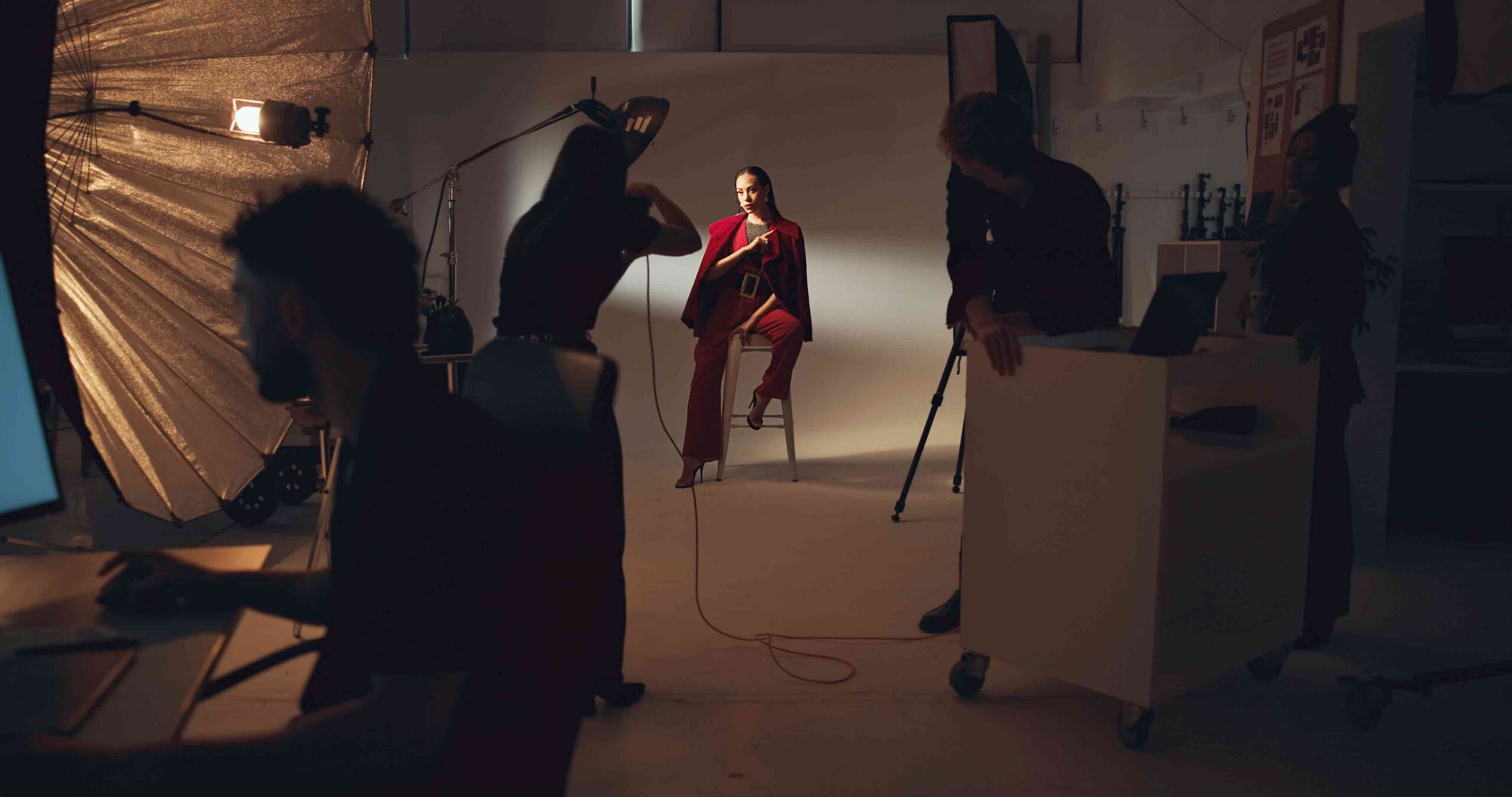
In studio fashion photography, lighting grants photographers precise control, drawing from several different sources to highlight desired textures or colors. Each light source serves a distinct function:
- The key light (which is also the brightest) sets the stage while drawing attention to the overall form of the subject.
- The fill light addresses any shadows created by the key light, adding contrast and a sense of depth.
- The back light adds drama and visual interest by highlighting the subject from behind.
On-Location Natural and Mixed Light Strategies
Natural lighting can be uniquely flattering. Photography’s beloved ‘golden hour’ creates warm, dreamy images by avoiding the harsh appearance of the midday sun. This is a great option for novice photographers who lack access to their own studio space.
Despite these advantages, natural lighting does present risks and is not automatically superior to hard or studio-based lighting. Finding the right conditions can be tricky, and even when this is achieved, frequent exposure adjustments may prove necessary. Mixed lighting mimics the aesthetic appeal of natural light but places this within the studio, where greater control can be achieved (and photographers are not at the mercy of the weather).
Camera, Lens and Technical Choices
The right camera can transform any photo shoot, elevating images even when captured by novice photographers. Versatile cameras are typically favored, allowing photographers to adapt as needed based on various clients, creative goals or lighting conditions.
Focal Lengths for Full-Body, Three-Quarter and Beauty Shots
Focal lengths determine how large the subject appears in the photo and how much of the surrounding scene is captured. This, in turn, influences framing and perspective. Focal length is typically expressed in millimeters, referencing the distance between the camera’s lens and its sensor.
Many fashion photographers favor 35mm shots, which are thought to limit distortion in full-body or three-quarter shots. The iconic 85mm focal length is widely regarded as the holy grail of portrait photography but can also be helpful for capturing the model’s unique features or in detailed images that convey intricate patterns or beautiful accessories.
Shutter Speed, Aperture and Motion for Fabric Flow
Shutter speed describes how long camera shutters remain open and the extent to which cameras are exposed to light. Faster shutter speeds may be better capable of freezing moments or capturing micro-expressions, although slower shutter speeds can add unique dimensions during dramatic shoots. The lens opening (known as aperture) determines both the amount of light and its intensity. This is expressed via F-stop, with low F-numbers indicating open apertures that allow more light to enter.
Color Management and White Balance
Fashion photographers prioritize color accuracy to accurately represent products while preserving the desired editorial aesthetics. This begins with correcting white balance and colors as needed so that images appear natural. Color management further supports accurate visuals by ensuring that colors remain consistent for every phase that follows the initial photo shoot. This acknowledges that, in editing and even delivery, colors can potentially shift.
Directing Models and On-Set Communication
Fashion photographers rely on models to embody specific moods or concepts while also revealing how garments fit or flow. Selecting the right model for the shoot is critical, of course, but even the most talented models will struggle to showcase garments if photo shoots feel unorganized or unsafe. This is where effective on-set communication makes all the difference.
Posing Cues, Action Prompts and Micro-Adjustments
In fashion photography, every pose or gesture serves a purpose, like drawing attention to the garment or capturing the overarching theme of the photo shoot. Simple cues help fashion photographers convey how they want models to pose, driving visual interest while calling attention to core clothing features. Micro-adjustments bring fluidity to these poses by preventing models from reading as rigid or awkward.
Building Trust and Confidence With Models
Models will respond better to cues or suggestions if they’ve developed rapport with photographers. This begins with respect, honoring models’ boundaries and encouraging them to share their fashion photoshoot ideas. Models prefer to feel like collaborators rather than like subjects, after all, and will be more receptive to model posing tips if they view themselves as a central part of the creative process.
Shooting for Different Platforms and Formats
The evolution of fashion photography has included a clear expansion regarding where and how we access curated, fashion-forward imagery. Today’s versatile fashion photographers should be prepared to adapt their work to reflect a growing range of formats or platforms, optimizing images to appeal to different clients or audiences.
Editorial Spreads, Covers and Double-Page Layouts
Editorial fashion photography goes beyond simply showcasing products, using clothing or accessories for narrative functions while also pushing creative boundaries. Dramatic or even surreal, fashion editorial photography includes eye-catching covers and double-page spreads that create immersive worlds in which models and sets evoke powerful emotions while contributing to cultural discourse.
Commercial Catalogs and E-Commerce Grids
While the public’s vision of fashion photography largely revolves around elevated editorial shoots, commercial fashion photography also has a key role to play. This is less about abstract or aspirational imagery; instead, the goal is to accurately convey images so that customers know what to expect.
For instance, e-commerce photography aims to drive conversions through images that showcase products, helping customers make informed decisions. Increasingly, similarly streamlined imagery is also used for branded social media product posts. Both digital strategies call for images that read well on small screens.
Vertical-First and Social Media Crops
Social media dominates modern marketing and is a major force in the fashion world. As such, contemporary fashion photographers must capture images that appear as evocative on social as they do in print. Orientation should be top of mind: Mobile-friendly vertical images appeal to users on Instagram or Pinterest, filling the screen while also showing off full-body styles within stories or Reels.
Post-Production, Retouching and Ethics
Photographers should not overly rely on post-production processes to fix flaws that emerge during photo shoots, as this can bring a sheen of artificiality or inauthenticity to otherwise expressive imagery. Still, post-production can overcome some issues — for example, preventing minor imperfections from distracting from the overarching theme of the high fashion photo shoot.
Basic Workflow: Culling, Color and Skin Retouching
Culling streamlines post-production by allowing photographers to focus on the images that best capture the intended mood or concept. Duplicates or unflattering shots are discarded, with only the best images preserved for fashion photo retouching.
From there, color correction keeps the tone and contrast in line with the artistic vision and client branding. Additionally, skin retouching adds polish while keeping the focus on the clothing. There is a growing demand for responsible retouching, which aims to preserve the characteristics of the model and the showcased garments instead of causing models to look overly processed.
Preserving Fabric Detail While Refining Skin and Makeup
Excessive editing risks removing the very details that distinguish garments. Selective retouching uses layers or precise pen tools to address skin imperfections while preserving textures and stitching. While some photographers handle retouching on their own, many now turn to professional retouchers. For example, Ukrainian (and now Munich- and Paris-based) fashion photographer Illya Ovchar asserts that retouching qualifies as a “standalone craft.”
Business, Rights and Collaboration
Fashion photography demands both a deep understanding of fashion design and photography techniques as well as insight into the business side of the fashion industry. Image licensing can prove especially complicated, but without a proactive strategy, photographers risk limited control surrounding how their work is used and how they are ultimately compensated.
Rates, Usage, Licensing and Buyouts in Fashion Work
Fashion photographers may be driven by passion, but the financial side of the industry warrants attention. Pricing can be a sensitive and overwhelming topic; rates are determined based on experience and the scope of the project but also heavily influenced by the client’s budget and by usage rights. Models may receive additional fees (known as buyouts) if the images in which they are featured continue to be utilized beyond the originally designated parameters.
Call Sheets and Shot Lists
Call sheets bring much-needed organization to fashion shoots. This details the shooting schedule (including the date, time and length of the shoot), the location and even the concept or theme — captured in a simple yet evocative phrase or sentence. The shot list expands on this to include what will happen during the actual shoot: i.e., who will be photographed and which angles or backdrops will be used along the way.
Case Studies: Global Perspectives
Some fashion photographers have broken into the mainstream, becoming household names in their own right. Standout photographers capture public fascination due to their distinctive creative vision and recognizable aesthetics. Below, we highlight a few top fashion photographers from around the globe, plus how they’ve become the true tastemakers of our time.
Paris: Haute Couture Editorials and Classic Studio Glamour
France has long been at the forefront of haute couture, so it should come as no surprise that top French photographers capture such elegant yet dramatic images. French icon Guy Bourdin helped to establish our modern concept of daring French fashion photography with provocative images that captured the attention of an entire generation. Giorgio Armani references this provocation but speaks most highly of Bourdin’s “creative freedom, his narrative skill and his great love of cinema.”
New York: Celebrity Iconography and Unforgettable Editorials
Although she refers to herself as the “un-fashion photographer,” Annie Leibovitz’s influence has been undeniable — having engineered true cultural touchpoints with her evocative images of John Lennon, Whoopi Goldberg and Demi Moore. As a New York fashion photographer, she has captured the fascinating intersection of style and celebrity, creating monumental imagery that feels both bold and intimate.
Lagos: Social Narratives and Community-Driven Imagery
Eager to capture the hidden elements of the human experiences, Lagos-based photographer Stephen Tayo works in Nigeria’s disadvantaged communities, demonstrating how policies influence social mobility. Tayo believes that “fashion holds more than aesthetic value for Nigerians,” explaining that it serves a cultural and political purpose: It’s a way to “show solidarity, telegraph status and make a public statement.” A critical element of Tayo’s work involves “staging through photo manipulation and collage,” which adds visual depth and heightens the conversation around identity and social hierarchy.
Mumbai: Bollywood and Luxury Fashion Fusions
India’s vibrant Bollywood culture has a profound influence on local fashion, exemplified by rich colors and stunning embellishments. This culturally evocative glamour is beautifully captured by local photographer A.Rrajani, who has worked with several of Mumbai’s top Bollywood stars. Speaking to his enduring legacy in the fast-paced Bollywood industry, A.Rrajani explains, “I don’t chase trends. I chase truth — how light falls, how a gaze lingers, how silence looks in a still image.”
Copenhagen: Exploring the Beauty of Simplicity with Minimalist Aesthetics
Capturing the Danish ethos of minimalism, Casper Sejersen prioritizes simplicity as a means of conveying complex concepts. Sejersen explains, “I like to shoot simple things because then the viewer can put their own stories onto the objects instead of having something described too clearly. There is a beauty in simplicity.
Building a Portfolio and Career Path
If you’re inspired by the fashion photographers highlighted above and eager to chart your own path in a promising industry, take steps now to explore creative possibilities as you begin to build your portfolio. Your curated collection of images demonstrates technical and artistic skills and could open the door to editorial or commercial projects.
Sequencing a Portfolio for Agencies, Brands and Editorial
The ideal fashion photography portfolio will convey both versatility and aesthetic alignment. The order and flow of selected images should not only reflect the photographer’s artistic and technical strengths but also demonstrate a clear understanding of the client’s priorities. This can be a key tool for landing campaigns or even launching a fashion photography business.
Online Presence: Websites and Social Media
With networking increasingly taking place online, today’s top fashion photographers prioritize their digital presence, curating virtual portfolios that attract attention. Photo-focused websites showcase their core aesthetics and visions alongside examples of past work. Here, as in the photos themselves, web design details can be curated to capture mood and personality. An Instagram presence is essential, too, featuring favorite shots or behind-the-scenes details that shed light on the creative process.
Discover Your Creative Potential at RMCAD
As you explore creative possibilities in fashion design or fashion photography, look to Rocky Mountain College of Art + Design (RMCAD) for inspiration. We offer multiple programs that encourage you to live out your creative ideals.
Our Bachelor of Fine Arts in Fashion Design is available online and on campus, with classes on textiles and illustration promoting fashion fluency. The Bachelor of Fine Arts in Photography reveals the conceptual and narrative elements of contemporary photography, covering darkroom techniques and post-production along with the business side of the industry. Request more information or explore more of our other artistically driven programs.
FAQs: Fashion Photography
Q1: How is fashion photography different from portrait photography?
Fashion photography is highly curated, focusing on specific garments or designers. Portrait photography, by contrast, focuses on the subject (especially their personality or presence) as opposed to what the subject is wearing. In fashion photography, elements such as lighting and composition serve the garment and brand story, creating a visual narrative that conveys style and brand identity.
Q2: Do I need a full studio to start in fashion photography?
Fashion photographers can capture compelling images by working in outdoor settings and making the most of natural lighting via outdoor fashion photography. Studio settings enhance control, but a lack of a studio can be overcome with strong direction and strategic styling.
Q3: What lenses work best for fashion shoots?
Style and environment determine the ‘ideal’ lens, though this can be a highly personal decision from the photographer’s perspective. Environmental looks benefit from 35mm and 50mm, whereas 85mm or even 135mm deliver flattering shots that showcase the model’s natural beauty.
Q4: How do I direct models if I am new and nervous?
Novice fashion photographers can use visual guides known as pose references to communicate ideas or instructions regarding body positioning or facial expressions. Simple, action-based directions get the point across — but should be accompanied by positive reinforcement and respectful feedback.
Q5: How much retouching is appropriate in fashion photography?
Retouching can refine images by limiting visual distractions yet should not cause images to feel inauthentic. Maintain realistic skin texture and body shapes while addressing potential distractions. Align retouching practices with the preferences of the client and the model.
Q6: How can I build a fashion portfolio without big clients?
Work with emerging models, stylists or makeup artists to plan mutually beneficial photo shoots that help a variety of professionals expand their portfolios. Concept-driven projects should be presented as cohesive editorials to capture attention and convey creative vision.
Q7: What are common challenges on fashion sets?
Shifting client preferences can make planning difficult, especially if photographers need to adjust their vision to reflect client demands. Other concerns may be more straightforward but also more difficult to overcome. For instance, shoots may be compromised by adverse weather or wardrobe malfunctions.