Outside, we find mirrors in reflecting pools, rain puddles and sheets of ice. In interior design, they’re commonly made of metal-backed glass and used in a variety of ways to enhance spaces.
Whether they’re hung from floor to ceiling in a high-glam, contemporary living room or helping expand the feel of a small living space in a DIY design project, mirrors can completely transform the look, feel and light in an interior space. So, let’s jump through the looking glass to explore how mirrors influence interior spaces, function in design and can be used effectively to complement any style or taste.
How Mirrors Influence Interior Space
Displayed indoors, mirrors can be used deliberately to influence a space.
Enhancing Natural Light and Artificial Light
One of the most common purposes of mirrors in interior design is to reflect, distribute and enhance the light inside a room. Mirrors don’t actually amplify light by creating additional photons, but they do create the illusion of more light by reflecting existing photons around a space.
Placed on a wall that opposes a window or on a wall that is perpendicular to a window, a mirror will reflect the view and spread natural light throughout a room. Additionally, combining lamps and mirrors in an interior space can help reflect and spread artificial light.
Creating the Illusion of Space
In addition to brightening a room, the enhanced light provided by mirrors helps create an illusion of more space. Mirrors also extend the visual depth of a room by extending visual boundaries to create the illusion of a larger space.
Mirrors can also make objects seem virtually invisible. For example, mirrored cabinets or furniture, such as mirrored coffee tables, blend into their surroundings, visually expanding the apparent negative space in a room.
Adding Depth and Dimension
Mirrors expand visual boundaries by reflecting the surrounding environment. This reflection can make a space feel boundless, and designers can create the potential for limitless depth by using multiple mirrors in a space.
By placing large mirrors along a wall, a designer can effectively double a room’s perceived size. This technique is especially effective in small rooms or narrow spaces, like corners, hallways and even low ceilings. It’s important to use high-quality mirrors that reflect a high-resolution image to create depth with an illusion of space.
Strategic Mirror Placement Tips
Mirror placement is vital for design and functionality. When placing a mirror, consider its purpose in the space.
Opposite Windows or Light Sources
Placing a mirror opposite or perpendicular to a window or other light source will brighten a space and enhance the light. Be careful to avoid direct sunlight, as this can result in an unpleasant glare and even damage a mirror.
Behind Furniture and Focal Points
Mirrors can help expand the apparent size of a space while adding depth and anchoring focal points throughout a room. For example, mirror decor for a living room is commonly used in two ways:
- Decorative wall mirrors can be hung above a fireplace to draw the eye to the focal point of a living room.
- Large floor mirrors or wall mirrors can be layered behind a sofa or chair to create the illusion of space behind the furniture.
In Tight or Awkward Spaces
Designers often use mirrors for small spaces (such as hallways, corners or odd nooks). In these spaces, mirrors help to expand the space, preventing the “tunnel effect” in a long, narrow hallway and making small rooms feel less claustrophobic and more expansive.
Mirrors as Design Statements
In addition to playing an essential role in design, mirrors can stand alone as design statements in their own right. Modern mirror design features decorative mirror frames, different shapes, a variety of sizes and the potential for an eclectic look achieved with layering and grouping.
Framing and Style Choices
Mirrors come with and without frames. Whether you choose a framed or unframed mirror depends on the style of the space you’re designing.
Frameless mirrors create a more modern, contemporary look. They are also more appropriate for mirror walls when you truly want to create an illusion of an expansive space.
Mirrors with frames can be especially useful when you want to complement a specific style, add texture or create whimsy in a space. You can choose a mirror with a frame of any color, made of metal, carved from natural wood or a frame featuring sculpted design elements. Mirror frames provide real flexibility and potential in decorating.
Shapes and Sizes That Change the Room
When choosing a mirror, consider the size and shape of the room and the location where it will be displayed to help determine the best size and shape. Square mirrors create a colder, more industrial look, while rounded mirrors are softer and less imposing. You can also find funky mirrors with wavy edges that can be used to create more of a focal point in a playful space.
Decorative Mirror Arrangements
Like creating a gallery wall, mirrors can be arranged in groups to create a wall of reflections. These eclectic groupings can be interesting focal points while spreading light and adding depth to a room. Depending on how you arrange the mirrors, they can all be the same and arranged in a grid, or they could include different styles with frames made of the same material for unification.
Practical Considerations for Mirror Use
When you’re ready to begin incorporating these mirror design ideas into your spaces, be mindful of the following considerations
Safety and Maintenance
Handling Mirrors – When handling and hanging a mirror, you must be careful. Since mirrors are made of glass, they are delicate and can also have sharp edges that cut easily. This is especially true of frameless mirrors. So, wear protective gloves when handling mirrors and carry large mirrors with help.
Hanging Mirrors – For hanging mirrors, be sure you check the total weight of the mirror and use the proper mounting hardware to ensure it is hung securely. For free-standing mirrors, ensure the mirror is properly supported or anchored to a wall to prevent it from tipping over.
Concave Mirrors – Especially popular in bathrooms and on vanities, concave mirrors that make a reflection appear larger can present a safety hazard if exposed to direct sunlight. This type of mirror can act like a magnifying lens, concentrating sunlight on a specific point. On a sunny day, this could start a fire.
Avoiding Common Mistakes
Some of the most common mistakes made in interior design with mirrors include:
- Incorrect Placement – Functional mirrors should be placed in a way that feels balanced on a wall while being useful. Often, mirrors are hung too high for people to see their reflections.
- Size and Proportion Mistakes – The size of the mirror should be in balance with the size of the space. Mirrors for small rooms should go in small spaces, and mirrors for large rooms should go in large spaces. Large decorative mirrors in small spaces can feel overwhelming (unless it’s a mirror wall), and small decorative mirrors are often inconsequential in large spaces.
- Reflection Problems – Another big mistake is failing to consider a mirror’s reflection. While you want a mirror to create light in a space, reflecting direct sunlight can cause an unpleasant glare, damage the mirror or even be hazardous. Additionally, be sure you’re reflecting a pleasant view, not a cluttered space or messy exterior.
- Seasonal Changes – When placing mirrors that reflect light or exterior views, designers should also consider how seasonal changes (i.e., the location of the sun, the color of the light and the color of the foliage) will impact the interior effect.
- Exposure to Moisture – Moisture can damage mirrors. When exposed, moisture can seep into the silver backing of a mirror, causing black or brown spots to form (called silvering). While some moisture, especially in the bathroom, can’t be avoided, be sure to choose a mirror that is water-resistant and place it above the sink so that it won’t get directly splashed.
Additionally, depending on the client, Feng Shui principles concerning mirrors might also need to be considered. According to Feng Shui principles, mirrors facing each other can multiply and trap negative energy, and mirrors facing the bed can disrupt sleep.
Matching Mirrors to Room Purpose
In design, remember that form follows function, and mirrors are among the most functional wall decor ideas. A thoughtful designer always considers the function of a mirror before choosing its size, style and placement.
When choosing mirrors for specific rooms and deciding where they will be placed, a designer should select and place them in a way that is both attractive and functional, matching the room’s purpose.
For instance, a mirror placed in an entryway or near the exit of a home should be hung at eye level so that the mirror opens up the space while also allowing people to check their appearance on the way out the door. Bathroom mirrors should be selected to match the style of the bathroom and hung at an appropriate height. Additionally, choosing a backlit mirror for the bathroom will increase the mirror’s functionality when a person styles their hair or does their makeup. Full-length mirrors work best in bedrooms or large dressing closets, allowing a person to view their outfit from head to toe.
Real-Life Examples and Inspiration
From expansive, mind-bending public spaces like the Chongqing Zhongshuge Bookstore to small, personal homes, it’s always helpful to see how expert designers and decor enthusiasts have used mirror trends in real-life spaces for decorating inspiration.
Modern Minimalist Spaces
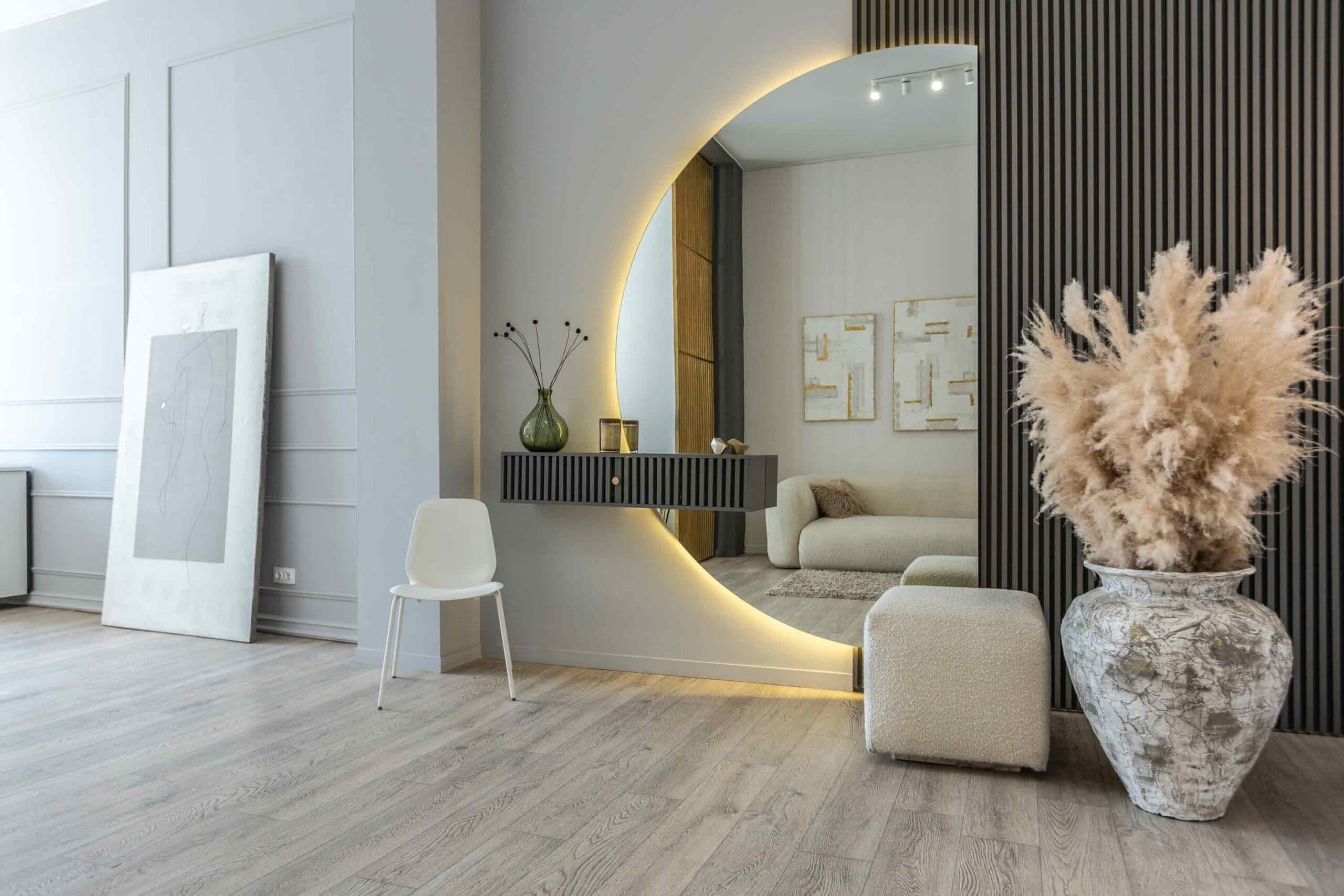
In modern, minimalist spaces, mirrors justify their place in the home by functioning as art, decor and a place to check your fit before leaving the house. To achieve this look, choose mirrors with clean lines, simple shapes and sizes appropriate for the space.
Glamorous or Vintage Interiors
For a more glamorous, vintage look, choose antique mirrors with ornate frames in a wide variety of shapes to create a single focal point with a large mirror or a displayed collection with several smaller mirrors.
Small Apartments or Studio Spaces
Mirrors are perfect for expanding the feeling of small spaces like apartments and studios. Create a wall of mirrors to double the perceived space, use strategically placed mirrors to reflect more light and consider installing mirrored cabinets or other mirrored furniture to help your necessary things disappear into the background.
What Do You See Reflected in Your Interior Design Future?
At Rocky Mountain College of Art + Design, our Interior Design degree program can help you develop your design talents, hone your artistic eye and acquire the skills you need to become a successful interior designer. With both in-person and online Bachelor of Arts in Interior Design tracks, you can take your mirror decoration ideas and interior design skills to the next level on campus or from any place you call home. Request more information to learn more today.
FAQs: Role of Mirrors in Interior Design
Where should you place a mirror in a room?
Placement depends on what you want the mirror to accomplish. To brighten a space, position it opposite or perpendicular to a window or other light source, while avoiding direct sunlight that can cause glare or damage the mirror. To anchor a focal point, hang a decorative mirror above a fireplace or layer a large mirror behind a sofa or chair to suggest depth beyond the furniture. In hallways, corners, and awkward nooks, mirrors counteract the tunnel effect and keep tight spaces from feeling claustrophobic.
Do mirrors actually make a room look bigger?
Yes, though the effect is perceptual rather than physical. Mirrors extend a room’s visual boundaries by reflecting the surrounding environment, which makes the space read as deeper than it is. A large mirror placed along a wall can effectively double a room’s perceived size, and the technique works especially well in small rooms, narrow hallways, and spaces with low ceilings. Mirrored furniture, such as a mirrored coffee table or cabinet, adds to the effect by blending into its surroundings and visually expanding the open space in a room.
Do mirrors really add more light to a space?
Mirrors do not create additional light, since they cannot generate new photons. What they do is reflect and redistribute the light already present, which produces a convincing illusion of a brighter room. A mirror positioned across from or perpendicular to a window spreads natural light and the outdoor view throughout the space. Pairing mirrors with lamps works the same way for artificial light, bouncing it into corners that would otherwise stay dim.
What size and shape mirror should you choose?
Match the mirror to both the room and its intended spot. Proportion matters most: oversized decorative mirrors overwhelm small rooms unless you are deliberately creating a mirror wall, while small mirrors tend to disappear in large spaces. Shape carries its own mood. Square mirrors read as cooler and more industrial, rounded mirrors feel softer and less imposing, and wavy-edged mirrors create a playful focal point. Frameless mirrors suit modern, contemporary interiors and mirror walls, while framed mirrors let you introduce texture, color, or whimsy that complements a specific style.
What are the most common mistakes when decorating with mirrors?
Several errors come up repeatedly. Hanging a functional mirror too high is common, leaving people unable to see their reflection. Getting proportion wrong throws off the balance of a room. Failing to consider what the mirror reflects is another pitfall, since a mirror can just as easily double a cluttered corner or a messy exterior view as a pleasant one. Direct sunlight causes glare and can damage the glass. Seasonal shifts in the sun’s position, light color, and foliage also change how a reflection reads across the year.
How do you keep mirrors from getting damaged?
Moisture is the main threat. When it seeps into a mirror’s silver backing, it produces black or brown spots, a process known as desilvering. In bathrooms, where humidity is unavoidable, choose a water-resistant mirror and mount it above the sink rather than somewhere it will be splashed directly. Handling matters too: mirrors are glass with sharp edges, especially frameless ones, so wear protective gloves and get help carrying large pieces. Check the total weight before hanging and use appropriate mounting hardware, and anchor free-standing mirrors so they cannot tip.
Are concave mirrors safe to use in a bathroom?
Concave mirrors are popular on vanities because they magnify a reflection, but they carry a real safety consideration. A concave surface behaves like a magnifying lens, concentrating sunlight onto a single point. If such a mirror sits where direct sun reaches it, that concentrated heat can be enough to start a fire on a sunny day. The practical fix is to position magnifying mirrors away from direct sunlight or to cover or angle them when not in use.