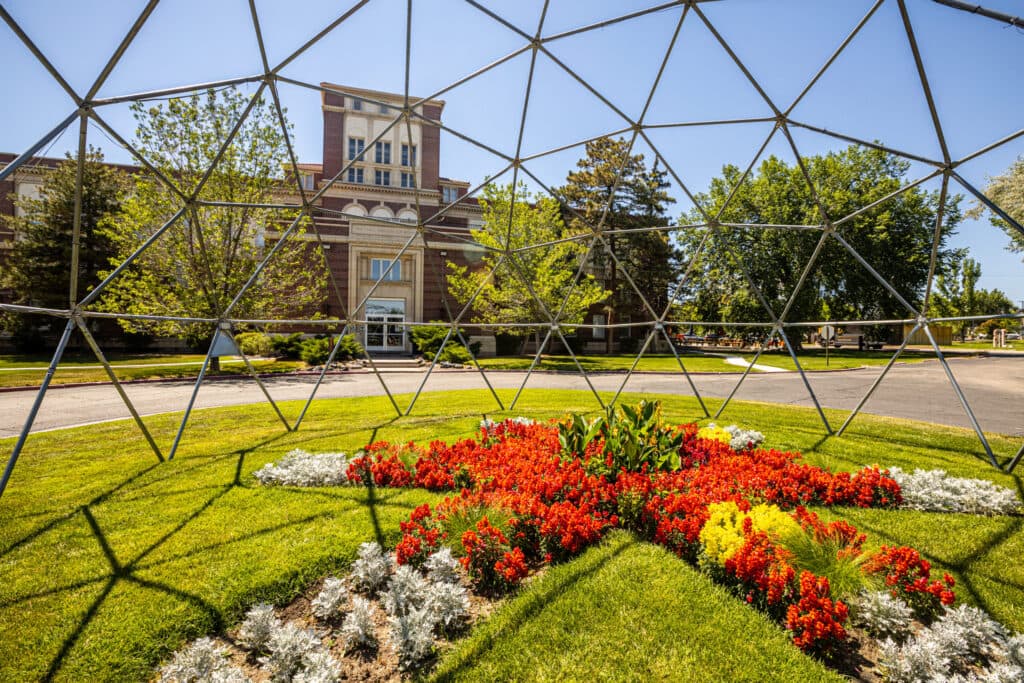
Spectacle is the cognitive gap between what your eyes are seeing and what your brain comprehends at first glance. Perhaps you have experienced it before whilst staring down the grandeur of the Grand Canyon or maybe the precision of a doll house? It is one of the fastest shortcuts for artists to wow their audience, and it’s often achieved through the art’s scale.
What Is “Scale” in Art?
Scale refers to the size and ratio of something. In art, an object can be recreated at varying scale and proportion to achieve awe inspiring results. So long as the original ratio of width, height, and depth are preserved the scale remains intact. If one of these dimensions is even slightly off, it can create a warped or uncanny version of its subject.
Physical Scale Versus Visual Scale
Just because a person or item looks massive or miniature does not mean that it is. Clever artists can harness forced perspective which uses clever positioning to distort the audience’s perception of an item or a person’s true physical scale. Perhaps the best example of this type of visual trickery is the movie magic in The Lord of the Rings franchise which used forced perspective to make Sir Ian McKellen look massive in comparison to Hobbit actor, Elijiah Wood.
Proportion, Hierarchy, and Viewpoint
Scale can also be one of many techniques put to use in a single piece. By having a figure in a painting take up a higher proportion of the canvas than the others, artists can create a visual hierarchy that not only leads the eye in a captivating way but also conveys the larger figure’s significance in the painting.
Scale, Space, and Audience Distance
Viewer positioning is a detail often underestimated by artists when considering how their audience will appreciate their work. However, the distance between finalized pieces and audience members is a primary consideration for gallery curators. Curators understand how spatial perception plays a key role in how viewers comprehend and contextualize art.
Small-Scale Strategies: Miniatures and Intimate Works
When you first think of scale, your mind may think big, but just as much hard work and detail goes into creating uniquely small things, such as miniatures at the proper scale. When measuring projects by centimeters and millimeters, the room for error becomes far narrower.
Psychological Effects of Intimacy and Control
According to Hilliard’s Portrait Miniatures: Intimacy, Presence, and Control, miniature paintings played an important role in the court of Queen Elizabeth of England serving “as the ideal vehicle for the symbolic communication of intimacy and devotion.” These intimate depictions of figures of nobility dressed in fine clothing and priceless jewelry served a distinct purpose in Elizabeth’s court. “Through their layers of secrecy and distinctive presence, portrait miniatures were key players in social and political games.”
Techniques for Detail, Precision, and Finish
Outside of high-end art galleries, miniatures or “minis” are also exceptionally popular as player totem’s in table top role playing games such as Dungeons & Dragons and Warhammer. As such, there are massive online communities dedicated to 3D printing, painting, and dry brushing miniatures to achieve an exact design.
Display, Framing, and Lighting for Small Works
According to Archdaily.com, there are several easy tips for creating and displaying highly detailed models. Tips include selecting the proper space, considering lighting, and determining a consistent scale. By following these tips, artists can not only create beautiful miniature art but display it in a way that does the work justice.
Large-Scale and Monumental Works
Monumental art utilizes the power of scale to communicate something’s importance through enormity. Large scale spectacles can communicate the emotional impact of a historical figure or the gravitas of a memorial.
Site-Specific Installations and Land Art
Many of the most famous art installations are specifically designed for their surrounding environment, and in the case of land art installations they actually use materials from the environment like indigenous rocks and sticks. The most famous example of this is Spiral Jetty by Robert Smithson, who constructed a spiral from mud, rocks, precipitated salt crystals, and water on the Great Salt Lake in Utah.
Engineering, Fabrication, and Logistics
As you can likely imagine, with large scale installations come large scale issues. From staffing and safety to supply and tool sourcing, a lot of planning goes into executing the scale and proportion of these original works. More consideration is needed with more expensive materials and longer timelines.
Wayfinding, Safety, and Audience Flow
Wayfinding as the name suggests, is the act of ascertaining one’s location in a given space. In the world of art curation, wayfinding is a key consideration so that visitors can not only view large-scale works but also read and receive added context about the work as they flow through the surrounding area. When considering audience flow and wayfinding, it is especially important to consider safety, including ensuring fire extinguishers, first aid kits, and emergency exits are easily locatable and accessible.
Scale as Concept: Playing With Perception
Artists can not only lead the viewers eye in exciting ways with their work but can also toy with their perception by distorting scale. In 2D work, perception can be distorted by replicating the 3D word from a particular angle. In 3D work, this can be through the extensive use of mirrors, repetition, or by incorporating time-based media.
Forced Perspective and Optical Illusions
As previously mentioned, forced perspective is a one of a handful of optical illusions that artists use to surprise and confound viewers. Famous art installations that utilize optical illusions include Andrea Mantegna’ Camera Picta which depicts figures on the vaulted ceiling from a low angle to make them appear looming over the viewer in real life.
Multiples, Accumulation, and Repetition
Scale does not need to be a single item lifted to the status of spectacle. Using the repetition of a single item or element of design can create a grandeur from the simplest of things. Take the example of Yayoi Kusama who used the repeating pattern of polka dots in her installation art. The “Dots Obsession” series accentuated the repeating dots with the use of mirrors, proving that even the simplest of design choices can be elevated to become larger than life.
Sound, Light, and Time as Scaling Dimensions
The spectacle of scale can be recreated in epic ways using sound, light, and time. While museums have been using these tools for decades, a more recent example that elevates the form are drone shows. Through the repetition of hundreds of small drones with attached lighting, shows can literally fill the sky creating familiar images and synchronizing movement to music.
Curatorial and Pedagogical Considerations
For museum curators and gallery owners, there are many details worth considering when working with large scale art and small scale art. These can range from concerns as simple as space to as complex as ethical considerations.
Gallery Layout, Sightlines, and Accessibility
A primary concern for galleries is flow, or how visitors will navigate through the physical space and view all the desired works. With each new show, curators may need to reconsider their gallery layout so that the space is not only navigable for people of all mobilities but also directs their focus in intentional ways. Curators should ensure that large pieces do not distract from surrounding art or that smaller exhibitions don’t go unnoticed.
Permits, Shipping, Insurance, and Risk
Shipping both large and small scale art can be costly and comes with several risks. Art shipping can be more expensive for heavier items and may run the risk of damaging them in transit. For that reason, artists and art curators may want to look into the cost of art insurance. Finally, it is especially important to comply with all local and federal laws when shipping art, particularly when shipping internationally.
Audience Engagement and Interpretation
Artists and curators alike are always looking to design and curate highly experiential art to engage viewers in gallery spaces. The captivating nature of scale, both big and small, can bring audiences to new museums and exhibitions and help engage them in the art critically. One of the key benefits of these unique pieces of work is how they are able to get visitors talking and interpreting their own experience.
Case Studies
There are countless examples of how artists and designers utilize scale and proportion in their work to evoke powerful feelings in their viewers. Unique small scale art and large scale art all around Colorado are engaging their local audiences and drawing in travelers alike.
Miniature Series With Immersive Detail
For over 100 years, Tiny Town has captivated its visitors in Colorado’s foothills through astoundingly detailed and complex miniatures. Formed in 1915 by George Turner and opened to the public in 1920, Tiny Town resides near Red Rocks Amphitheater in Morrison, Colorado. Full of dozens of structures and even a railroad, Tiny Town is a work of miniature art.
Room-Filling Mixed-Media Installation
One of the most famous site specific installations in the world is the psychedelic sci-fi experience of Meow Wolf Convergence Station. Meow Wolf is a collaboration between countless artists of varying media and it credits the entire space as 324 unique projects that all come together to create a singular installation art experience.
Outdoor Public Sculpture With Community Interaction
When art is unencumbered by the confines of gallery space or museum space, it has permission to sprawl outward and reach towards the sky. Public art sculptures don’t just use scale for kicks. An enormous piece can become a waypoint in a neighborhood, making it an important part of the community’s interaction. In the case of Denver, the city is known for colossal blue animals such as Big Blue Bear by Lawrence Argent and Mustang by Luis Jimenez.
Scale your Aspirations!
From miniatures to monuments, there are a lot of engaging ways artists can use scale in their work. If you are interested in how to use scale in your work, then you may want to consider a fine arts degree program that provides you with an extensive foundation in the arts.
The Bachelor of Fine Arts degree at Rocky Mountain College of Art + Design allows you to explore a variety of artistic mediums and discover the works of artists from around the world. The skills-based degree program will enable you to establish a foundation that you can build upon, giving you the skills and knowledge to carry into a variety of artistic positions. Request more information about all of our degree programs today.
FAQs
Q1: How do I decide the right scale for a new artwork?
- Start with intent and audience distance. Define the emotion you want to evoke, where it will live (desk, gallery, plaza), and what resources and constraints you have (budget, time, shipping).
Q2: What is the difference between physical and visual scale?
- Physical scale is literal size; visual scale is how large a work feels due to proportion, contrast, perspective, and context. Small works can read “big” with bold forms and framing.
Q3: How can I make small works feel impactful?
- Prioritize high-contrast focal points, immaculate finish, magnifying display solutions, intimate lighting, and sequencing that invites close, prolonged looking.
Q4: What are key logistics for large installations?
- Plan for structural loads, modular fabrication, permits, insurance, transport, installation windows, safety routes, and maintenance. Build contingency time and budget.
Q5: How does scale affect accessibility?
- Consider audience flow, navigation paths, line-of-sight, captioning for media, tactile cues, and alternative encounters (seated viewpoints, audio descriptions, touch samples where appropriate).
Q6: How should I photograph works of different scales?
- Use human references or measurement props, wide shots for context, detail shots for craft, and consistent lighting. For installations, include floor plans and visitor flow images.
Q7: Can materials limit the scale I choose?
- Yes, material strength, weight, joinery, and weathering characteristics drive maximum spans, support points, and maintenance needs. Prototype and consult fabricators early.