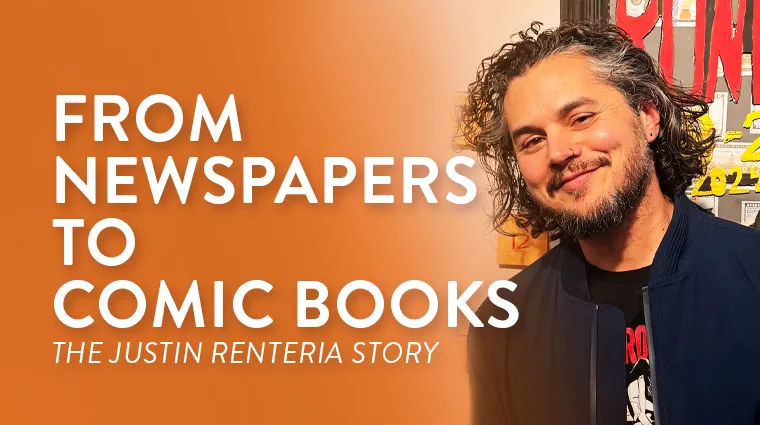

By the time Renteria graduated from RMCAD’s illustration program in 2006, he was already a self-proclaimed “news junkie.” He knew that he wanted to do more than just illustrate drawings. He wanted his work to illustrate the ideas that reflected the complex world around him. “I was coming into awareness of the world and what was going on in our country. So that was the impetus of why I kind of went towards editorial illustration,” shared Renteria.
You may not be immediately familiar with the term editorial illustration, however if you have spent any length of time reading articles from The New York Times, Slate Magazine, or The Los Angeles Times, you are certainly familiar with editorial illustrations. In fact, you may have even seen Renteria’s work in those publications. Editorial illustration is a “form of visual journalism where artists create drawings and graphics that support editorial articles.”
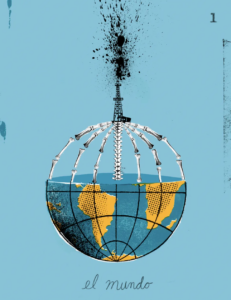
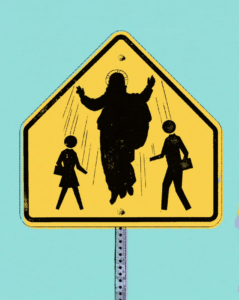
Renteria’s playful, highly saturated, and often satirical style is perfect for magazine and newspaper illustrations. His portfolio is full of pop-art-inspired, high-contrast mixed-media graphics. Combining photos and illustrations in eye-catching, metaphorical ways, his work is what convinces readers to dive into these articles. In the two decades since graduating, he has honed his skills as a freelance illustrator for a variety of publications and clients, but it hasn’t exactly been easy.
The Secret of Free Lancing
Renteria’s success story has been anything but a straight line. After graduating in 2006, he worked diligently to carve out a niche for himself as a freelance artist, before much of the digital infrastructure that exists today had become standard practice. He shared that he spent most of his time sending his stuff to potential clients. “Back then, I wasn’t using databases with art director information, such as emails and phone numbers. I’m sure it existed back then, but I wasn’t using it.”
The early part of Renteria’s career involved “a lot of legwork” just to get his foot in the door, not even to have his work considered. While holding down a full-time job at Target, he would go to the magazine section to check out the mastheads of publications for leads on industry contacts. Hitting the pavement meant a lot of cold calls, which as you can imagine, meant a lot of rejection.
Reflecting on his work during his salad days, Renteria admitted that even after having graduated, he still had a lot to learn. At one point, he reached out to the art director for the LA Times, who told him he didn’t think his illustration portfolio was ready, but he’d keep him in mind. But Renteria didn’t give up, he kept reaching out to more and more publications, and more importantly, he never stopped drawing.

Over the next few years, he continued to refine his skills, never losing sight of creating visuals that maximize the impact of the important news stories they would accompany. Until one day, that same art director from before, reached back out with an offer. After landing a commission with the LA Times, the jobs began to “snowball” for the young illustrator. All his hard work and dedication began paying off.
From there, Renteria’s work began getting noticed more and more by other publications. His sardonic blend of biting commentary and digitally collaged media made him a go-to for publications big and small. Throughout the 2010s, he continued to rack up more and more freelance illustration work. Sure, he was focused on editorial clients, but offers of all kinds started coming in for illustration jobs. Soon his client list included Slate Magazine, The Los Angeles Times, The Johns Hopkins Health Review, The New Yorker, The Atlantic, Fortune, ESPN, WIRED Magazine, Cosmopolitan, Newsweek, Scientific American, The Boston Globe, Wall Street Journal, Washington Post, and many many more.
Passing the Pencil to the Next Generation
While on this hot streak, Renteria realized that he was hardly more than 10 years out of college and had already exceeded his wildest dreams professionally, but something wasn’t right. Despite creating thought-provoking work, attaining a long client list, and garnering industry acclaim, Renteria found himself reaching for something he could not grasp. After years of undeniable success, he decided to take a step back from illustration. Reflecting on the shift in his career, Renteria shared that he had to “put his happiness first.”
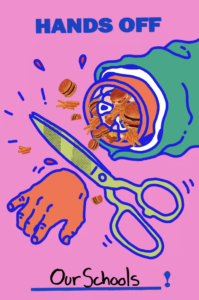
In 2019, Renteria decided to pivot into teaching. He had long been grateful of the many teachers he had in his youth, and as time continued to pass, he grew curious if it was something he was capable of doing too. Sure, it meant stepping away from more than a couple of high-paying editorial gigs, but for Renteria, money was never the reason to do anything. After years of working in relative solitude as a freelancer, teaching broke him right back out of his shell, forging lasting connections with students and teachers alike.
Throughout the school year, the unbridled imagination of Renteria’s students slowly reignited his creative spark. Soon, it came time to make another change. He returned to illustration just a few short years later when he was pulled out of retirement to do something completely new, the illustrations for a graphic novel retelling of The Prophet by author A. David Lewis. While the project meant leaving teaching for the time being, Renteria was excited to do his first-ever illustrations for a graphic novel. Even though it was a short period in his career, his time as a teacher was a profoundly impactful one.
The Prophet
Now, the challenge with illustrating for a graphic novel was that Renteria didn’t feel exactly “fluent” in comic books. “This whole time, I’ve loved comics and wanted to make them, but I never thought I was capable until I thought about what kind of comic I wanted to make. And it wasn’t anything like those superhero comics.” Lucky for him, The Prophet was about the furthest thing from a superhero possible.
The onomatopoetic action of the alliterative Peter Parker’s Spider-Man was a far cry from the subject matter of The Prophet, which is a collection of 26 prose poetry parables published in 1923 by Kahlil Gibran. Fortunately, that was exactly what attracted Renteria to the role in the first place. Nearly two decades after graduating, it was time he learned how to become a comic book artist, and he was up for the challenge! According to him, he has to “change to keep things fresh and exciting. So experimentation is definitely a must.”
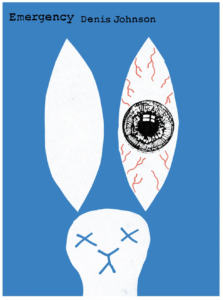
Accustomed to creating illustrations for editorial articles largely centered around current events, illustrating a graphic-novelization of a nearly 100-year-old book was about the last thing Renteria ever saw himself doing. However, with every illustration he drew, Renteria found solace in stepping outside of his comfort zone, panel by panel. There was the obvious pride in stretching the boundaries of his portfolio and skillset. “If I were to go back and look through my work from 2007 and compare it to my work from last year, there are some pretty drastic changes. Not just in the mediums and tools that I use, but also the aesthetic of my work has changed pretty drastically throughout that time. 20 years is a long time. It’s hard for artists to stand still stylistically.”
However, the strangest part of doing the comic book illustration of The Prophet was how familiar the process felt to him. One part of editorial illustration that Renteria enjoyed was that his art was always in conversation with the work of an author or journalist. He never feared the blank page, as there had always been some inspiration gifted to him by another creative mind. Strangely, that was also true with The Prophet. Sure, the author Kahlil Gibran died in 1931, but his book of prose poetry was alive and well, ready to breathe new life into the ink on Renteria’s page. Pair that with A. David Lewis’ adapted script and the partnership was off to the races with a bold new adaptation of the literary classic. Published in 2023, this version of The Prophet was published exactly 100 years after the original text.
That Justin Renteria is One Bad Hombre
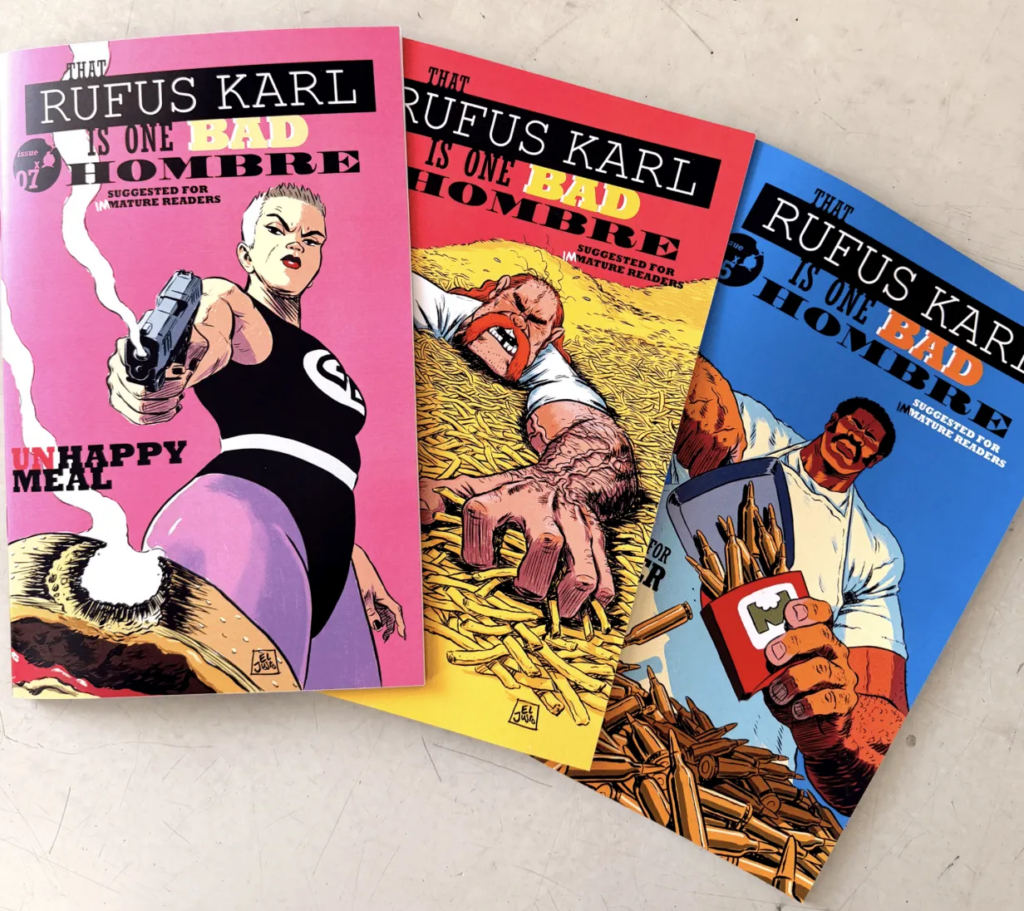
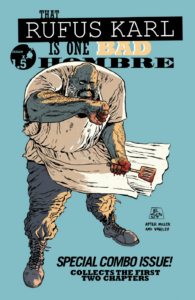
Not unlike the aforementioned Peter Parker, Renteria had been bitten by the comic book bug, and he was finding out that he was capable of all sorts of new and exciting things. But this time, Renteria decided to go beyond where he had ever gone before and tackle the blank page by himself. An experienced and at times jaded professional who feels his past life as a henchman pulling him back in for more, Renteria is in many ways the inspiration for his own self-published comic book, That Rufus Karl is One Bad Hombre.
Named Denver’s 2026 Best Local Comic Book by Westword magazine, That Rufus Karl is One Bad Hombre is a satirical reflection on work-life balance. Told from the exaggerated perspective of the eponymous Rufus Karl, the comic is a parody of the action-movie trope of a tough guy with a storied past, attempting to lead a quiet life when trouble comes knocking on his door, and he is “thrown back into this life that he thought he escaped from.” Having worked a million different gigs and lived a thousand lives as an illustrator, some greatly fulfilling and others just for a paycheck, Renteria says he draws on his own experience for the comic as a commentary on employment while “injecting a lot of humor into it.”
Unlike Rufus Karl, however, Justin Renteria is a man who knows the value of his past and is continually striving towards a bright future. Whether he’s collaborating with journalists by illustrating their reports on the complex issues of the day, sharing his insights with today’s youth and basking in their imagination, or broadening his horizons to chase his first-love of writing and illustrating comic books, Renteria is a creative who keeps pushing forward. What will he do next? Not even he can tell you. But one thing is for sure, it’ll be colorful!